
Everyone says you can eat for $20 a week.
I call BS.
I used to stress over hitting exact weekly budget numbers, meal prepping every Sunday like it was some test I had to pass. Color-coded containers. The whole Pinterest production. Turns out, I was micro-managing pennies while ignoring the macro wins - I was throwing away $14/week in spoiled food because I bought “fresh” ingredients that went bad before I could use them.
The breakthrough came when I stopped chasing those fantasy budgets and started working with real numbers.
Here’s the truth: If you’ve tried those “$20/week meal plans” and “failed,” you didn’t fail. The plan was unrealistic. Those articles use 2024 prices (or older), ignore food waste, and assume you’re feeding a family where bulk buying actually makes sense.
Let me show you what solo meal planning actually costs in 2026 - and how to do it without the guilt.
Why “$20/Week Meal Plans” Are Full of It (And Why You’re Not Failing)
I’ve seen them. You’ve seen them. Those articles promising you can eat on $20 a week if you just “meal prep smarter.”
They’re full of it.
Here’s why: They’re using prices from 2024 (or earlier). Chicken breast at $2.99/lb? That ship sailed. Eggs at $1.89/dozen? Maybe in 2019. A dozen eggs now averages $2.86. Boneless chicken breast is $4.15/lb. Rice is $1.07/lb, not the $0.67 those old articles claim.
Grocery prices are up 29% since February 2020. But those viral meal plans haven’t updated their spreadsheets.
The USDA publishes official food cost estimates every month. As of September 2025, their Thrifty Food Plan - the absolute minimum for nutritionally adequate eating - is $57.40 per week for a single adult.
Not $20. Not $30. Not even $50.
$57.40.
And that’s the bare minimum tier. Their “Low-Cost Plan” is $62.10/week. “Moderate-Cost” is $75.70/week.
If you’ve been beating yourself up because you can’t hit those fantasy numbers, stop. You weren’t failing. The plan was lying.
The Real Cost of Eating Solo in 2026 (Numbers Nobody Talks About)
Let’s talk about what nobody mentions: eating alone is more expensive per person.
When you’re cooking for one, you can’t split a 5-lb bag of potatoes before half of them sprout. You can’t finish a family pack of chicken before it goes bad. Recipes serve 4-6 people, forcing you to either eat the same thing for a week straight or throw food away.
The average American throws away $728 worth of food per year. That’s $14 per week in wasted groceries. And singles get hit hardest - 40% of that waste is produce that spoils before you can eat it.
Here’s what food actually costs right now:
| Item | 2026 Price | Old Article Claims |
|---|---|---|
| Chicken breast (boneless) | $4.15/lb | $2.99/lb |
| Chicken thighs (bone-in) | $3.49/lb | $1.99/lb |
| Eggs (dozen) | $2.86 | $1.89 |
| Rice (white, 1lb) | $1.07 | $0.67 |
| Potatoes (5lb bag) | $5.05 | $2.99 |
| Bananas (1lb) | $0.66 | $0.49 |
| Milk (gallon) | $2.29 | $1.49 |
These are Federal Reserve economic data averages - not “organic artisan” prices. Regular grocery store prices.
But here’s the thing: knowing the real numbers means you can actually plan for success instead of setting yourself up to fail.
Why Food Waste Hits Singles Harder
29% of US households are single-person. That’s a record high. But grocery stores still cater to families.
The “family size” chicken pack is cheaper per pound. But when you’re one person, half of it goes bad before you can eat it. The 5-lb bag of potatoes is a better deal than buying loose - until three pounds sprout in your pantry.
And recipes? Most serve 4-6. You either meal prep the same thing for six days straight (hello, flavor fatigue) or throw away leftovers.
Here’s what I learned: The “cheaper” bulk option isn’t cheaper if you throw it away.
$3.49/lb chicken thighs beat $2.99/lb family pack chicken if you actually eat the thighs and toss half the family pack.
Related: Budgeting for Beginners
Your $57 Weekly Grocery List (Actual Items + 2026 Prices)
Alright. Here’s what $57 actually buys in 2026.
This list is based on Walmart/Aldi averages from January 2026. Your region might vary 10-20%, but this is the baseline.
PROTEINS - $14.50
- Chicken thighs, bone-in, 2 lbs - $6.98
- Eggs, 1 dozen - $2.86
- Dried pinto beans, 1 lb - $1.69
- Peanut butter, 16 oz - $2.95
GRAINS/STARCHES - $8.25
- White rice, 2 lbs - $2.14
- Potatoes, 3 lbs - $3.03
- Rolled oats, 18 oz - $1.89
- Bread, whole wheat, 1 loaf - $1.19
PRODUCE - $12.80
- Bananas, 2 lbs - $1.32
- Frozen mixed vegetables, 2 bags (12 oz each) - $3.98
- Onions, 1 lb - $0.99
- Carrots, 1 lb - $0.89
- Canned diced tomatoes, 14.5 oz - $1.78
- Frozen spinach, 10 oz - $1.49
- Apples, 2 lbs - $2.37
PANTRY/DAIRY - $11.85
- Milk, half gallon - $2.29
- Butter, 1 stick - $1.49
- Shredded cheese, 8 oz - $2.79
- Cooking oil (prorated) - $0.85
- Salt/pepper/garlic powder (prorated) - $1.25
- Flour, 2 lbs - $1.89
- Sugar (prorated) - $0.45
- Soy sauce (prorated) - $0.84
SNACKS/EXTRAS - $9.60
- Saltine crackers, 1 box - $2.49
- Popcorn kernels, 2 lbs - $1.99
- Greek yogurt, 2 cups - $2.99
- Canned black beans, 15 oz - $2.18
TOTAL: $57.00
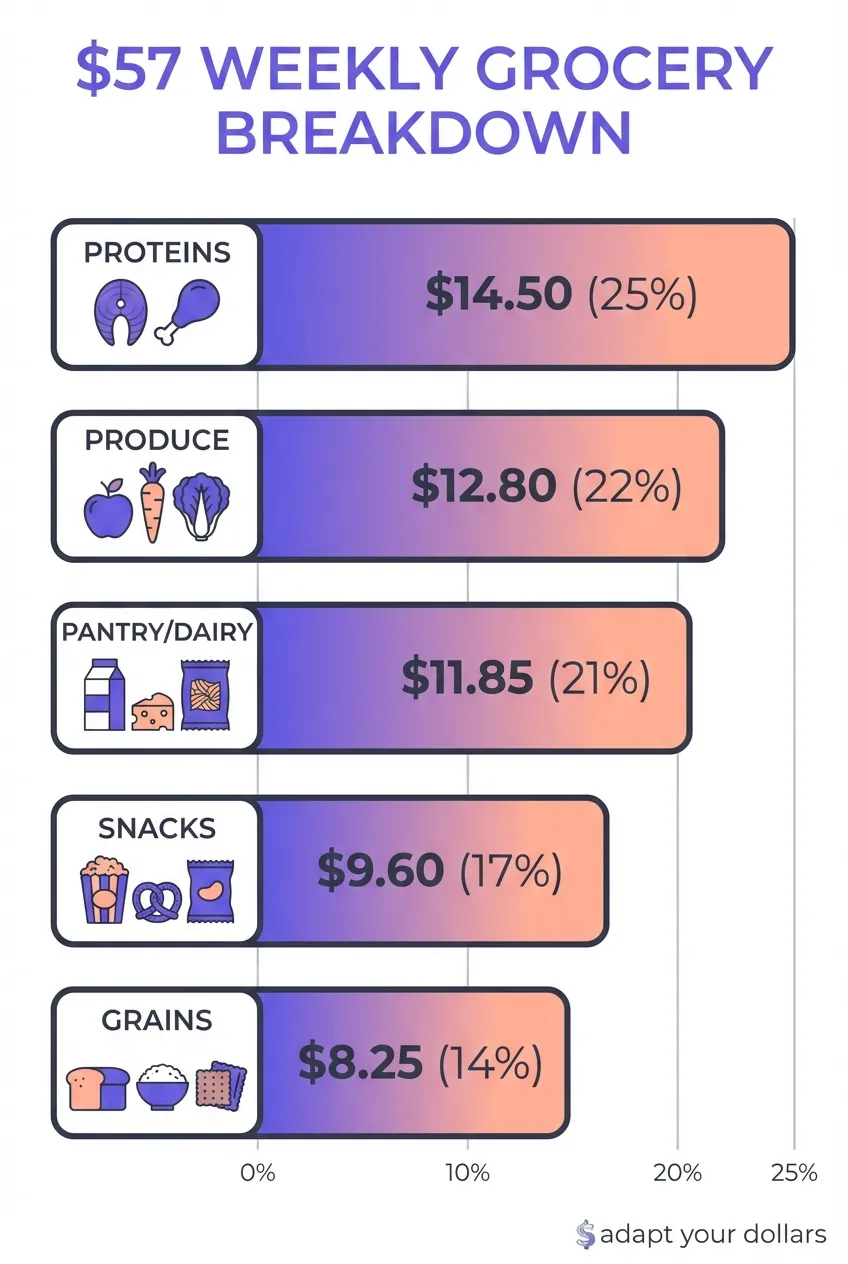
Yes, it’s tight. But it’s honest. This is what $57 buys when you’re using 2026 prices, not 2022 fantasies.
Related: Grocery List Budget for 1 Person
Your 7-Day Meal Plan (Zero Waste, Real Portions)
Here’s how you actually use that grocery list without throwing food away.
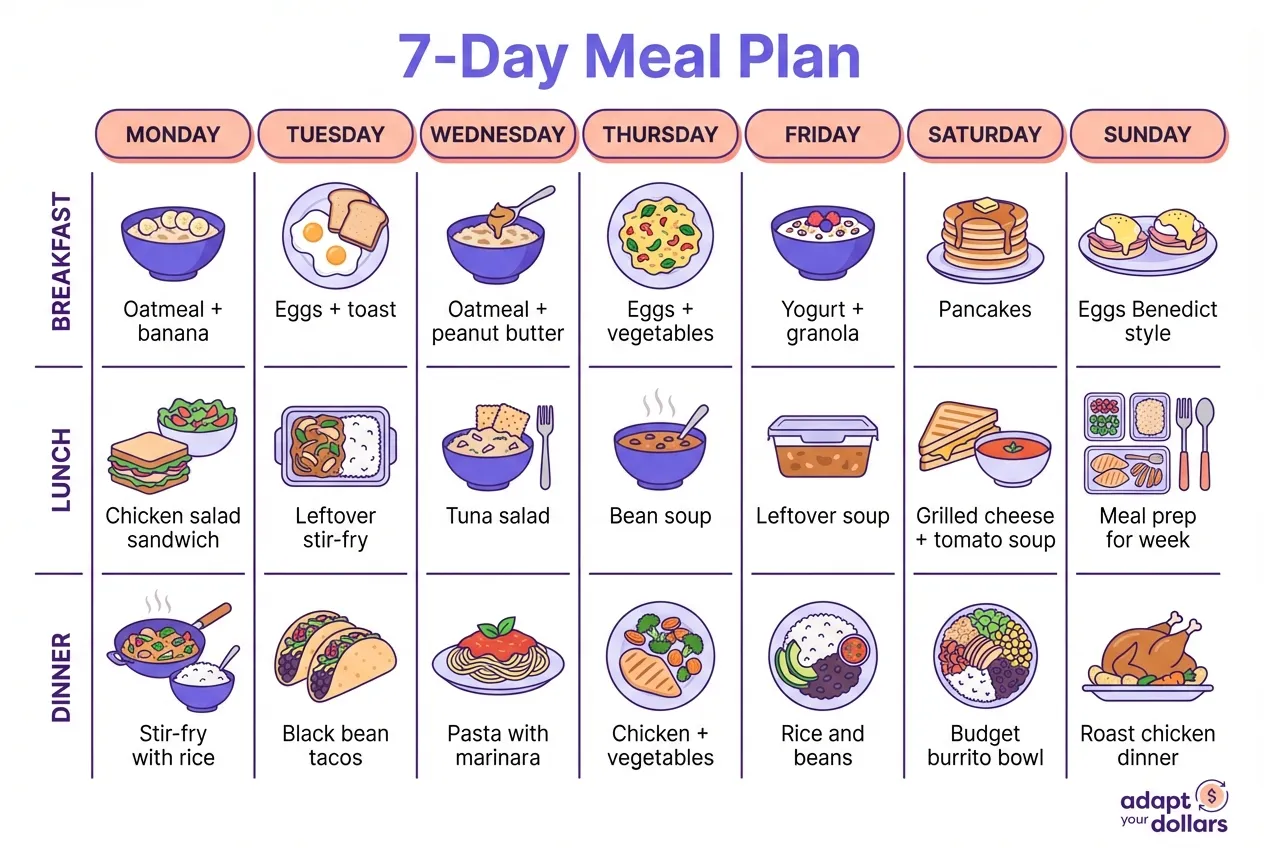
Monday
- Breakfast: Oatmeal with sliced banana, peanut butter
- Lunch: Peanut butter sandwich, apple, crackers
- Dinner: Baked chicken thighs, rice, frozen mixed veggies
- Snack: Popcorn
Tuesday
- Breakfast: Scrambled eggs, toast with butter
- Lunch: Leftover chicken and rice bowl with soy sauce
- Dinner: Bean and potato hash (black beans, diced potatoes, onions)
- Snack: Yogurt
Wednesday
- Breakfast: Oatmeal with banana
- Lunch: Egg salad sandwich, crackers
- Dinner: Chicken fried rice (leftover chicken, rice, frozen veggies, eggs)
- Snack: Apple slices with peanut butter
Thursday
- Breakfast: Toast with peanut butter, banana
- Lunch: Bean and cheese quesadilla (flour tortilla made from scratch, beans, cheese)
- Dinner: Baked chicken thighs, mashed potatoes, frozen spinach
- Snack: Popcorn
Friday
- Breakfast: Scrambled eggs with spinach, toast
- Lunch: Leftover chicken, rice, and veggies
- Dinner: Pinto bean soup (dried beans, onions, carrots, canned tomatoes)
- Snack: Yogurt with apple chunks
Saturday
- Breakfast: Oatmeal with peanut butter
- Lunch: Grilled cheese sandwich, crackers
- Dinner: Fried rice with eggs and frozen veggies
- Snack: Popcorn
Sunday
- Breakfast: Pancakes from scratch (flour, eggs, milk, sugar), banana
- Lunch: Bean soup with bread
- Dinner: Baked potatoes topped with cheese, frozen broccoli
- Snack: Crackers with cheese
Every ingredient from the list gets used. Nothing sits in your fridge until it goes bad. No guilt.
Related: Weekly Meal Plan With Grocery List
How to Actually Cut Food Waste When You’re Cooking for One
The real money leak isn’t buying organic. It’s throwing away $14/week in wilted kale and moldy bread.
Here’s what I learned:
Buy frozen over fresh for anything you won’t eat in 3 days. Frozen spinach, frozen veggies, frozen fruit - same nutrition, lasts months, costs less. Fresh kale is $2.49 and goes slimy in 4 days. Frozen spinach is $1.49 and lasts 6 months.
Shop twice a week instead of once. Two $28.50 trips mean fresher produce, less waste. The “one big trip” strategy works for families. For singles, half your groceries go bad before day 7.
Batch cook 2-3 portions, freeze individually. That bean soup? Make the full pot. Eat one bowl fresh, freeze two in single portions. Future you gets a free meal, and you’re not eating soup for 6 days straight.
Use the whole ingredient. Chicken thighs on bone? Save the bones. Simmer them with veggie scraps (onion ends, carrot peels) for free broth. Stale bread? Toast it, blend it, boom - breadcrumbs.
Store produce correctly. Bananas on the counter. Apples in the fridge. Potatoes in a dark cupboard, NOT with onions (they make each other spoil faster). Carrots in water in the fridge stay crisp for weeks.
Permission statement: Throwing away $14/week because you “should” finish fresh spinach is costing you $728/year. Buy frozen spinach. Save the $728. You’re not lazy - you’re smart.
The Math for Scaling Recipes Down
Most recipes serve 4-6 people. You need portions for 1-2. Here’s how to scale without a calculator.
If the recipe serves 6, divide everything by 6.
- 3 cups flour → 1/2 cup
- 6 chicken breasts → 1 breast
- 2 tablespoons salt → 1 teaspoon
If the recipe serves 4, make the full batch. Eat two portions fresh, freeze two. You’ve just meal-prepped lunch for later in the week without eating leftovers for 4 days straight.
When scaling doesn’t work: Baking. You can’t really bake 1/6 of a cake. Either make the full recipe and freeze portions, or find a “small batch” recipe designed for one.
For one-pot meals (soups, stews, casseroles): Make the full batch. These freeze beautifully. You’re building a freezer stash of homemade “convenience food.”
Pro move: Get a kitchen scale. Recipes say “1 chicken breast” but breasts range from 4 oz to 12 oz. Scaling by weight is more accurate than scaling by count.
But here’s the thing - you don’t need to be precise. Cooking isn’t chemistry. A little more rice, a little less beans? You’ll survive. Don’t let perfectionism stop you from cooking.
Related: Extreme Frugal Ways to Save Money
Where to Shop for the Best Solo Prices (Without the Bulk Trap)
Aldi/Walmart: Your baseline. Best prices on staples. No membership fee. Weekly ads for loss leaders (milk, eggs, bread sold at cost to get you in the door).
Costco: Skip it. Unless you have a chest freezer and can split bulk purchases with a friend, you’ll waste more than you save. That 10-lb bag of rice is cheaper per pound, but not if 6 lbs go stale before you finish it.
Discount grocers (Grocery Outlet, Aldi, Save-A-Lot): “Ugly” produce, dented cans, short-date items. Same food, 30-50% off because the packaging isn’t perfect. Your stomach doesn’t care if the can has a dent.
Ethnic markets (Asian, Hispanic, Middle Eastern): Bulk bins where you buy exact amounts. Need 1/4 lb of lentils? Done. No waste. Plus, spices are stupid cheap compared to those $4.99 McCormick jars.
Farmer’s markets: Hit them at closing time (last 30 minutes). Vendors would rather sell cheap than pack up. I’ve gotten $20 worth of produce for $7 because it was 5:30 PM and they wanted to go home.
Delivery apps (Instacart, etc.): The trap. $5.99 delivery fee + $3 service fee + tip + upcharges = you just paid $15 extra for groceries. If you’re on a $57 budget, skip it. Walk into the store.
Related: Frugal Living Tips
Time to Stop Pretending $20/Week Is Real
Look, I’m not going to tell you eating on $57/week is easy. It’s not.
But here’s what I learned: The real win isn’t hitting some fantasy number you saw on Pinterest. The real win is opening your fridge mid-week and NOT seeing $14 worth of wilted guilt staring back at you.
You’re not broken because you can’t eat on $20/week in 2026. That number was a lie. You’re also not alone - 29% of US households are solo. The grocery industry just hasn’t caught up yet.
Print this list. Try it for one week. Not forever. Not as some moral test of your frugality. Just one week to see what $57 actually buys when you’re working with honest numbers.
And when you don’t throw away half a bag of spinach this time? That’s the win.
Your move.

Written by
Chris
I went from checking my bank balance before every grocery run to building a $10K emergency fund. Now I share the exact strategies that worked—no jargon, no judgment.