
You’re standing in the grocery store at 5:47 pm, phone in one hand, cart half-full of random stuff. Your kid just texted asking what’s for dinner. You have no idea. Again.
Sound familiar? I used to do this three times a week. Sometimes four. Just wandering the aisles, grabbing whatever looked good, spending $847 a month on groceries for a family of four -and still ordering pizza because nothing in my fridge went together.
Then I started meal planning. Not the Pinterest-perfect, color-coded spreadsheet kind. Just a simple system that takes about 20 minutes on Sunday. That $847 dropped to $523 within two months. That’s $324 back in my pocket every single month.
Here’s the thing nobody tells you about meal planning on a budget: it’s not about being organized or having your life together. It’s about making one decision on Sunday so you don’t have to make 21 decisions when you’re tired, hungry, and surrounded by impulse buys.
Let me show you exactly how to do it.
Why a Weekly Meal Plan With Grocery List Saves You $200-400 Per Month
Before we get into the how, let’s talk about the why. Because you need to understand what’s actually eating your grocery budget.
The Hidden Costs of “Winging It”
When you shop without a plan, three expensive things happen:
1. You buy duplicates. You grab pasta sauce because you can’t remember if you have any. Spoiler: you have three jars at home. According to USDA research, the average American household wastes about 30-40% of their food -that’s roughly $1,500 per year thrown in the trash.
2. You fall for “deals.” That BOGO on chips? Great deal on something you didn’t need. Marketing teams spend billions figuring out how to make you buy stuff that wasn’t on your list.
3. You default to expensive convenience. No plan for Tuesday? Hello, $47 takeout order. One study found that households that meal plan spend approximately 25% less on food than those who don’t.
What Changes When You Have a Plan
A weekly meal plan with a grocery list flips the script:
- You buy only what you need. No more “just in case” purchases that rot in the crisper drawer.
- You use what you buy. When Monday’s roasted chicken becomes Wednesday’s chicken salad, nothing goes to waste.
- You eat at home more. Having a plan eliminates the “nothing to eat” excuse that leads to takeout.
The math is simple. If you’re spending $800-1000 per month on groceries and eating out, a meal plan can realistically cut that by 25-40%. That’s $200-400 back in your budget -every single month.
The 5-Step Weekly Meal Plan System (20 Minutes, Max)
Here’s the exact system I use every Sunday. No apps required. No complicated spreadsheets. Just a piece of paper and 20 minutes.
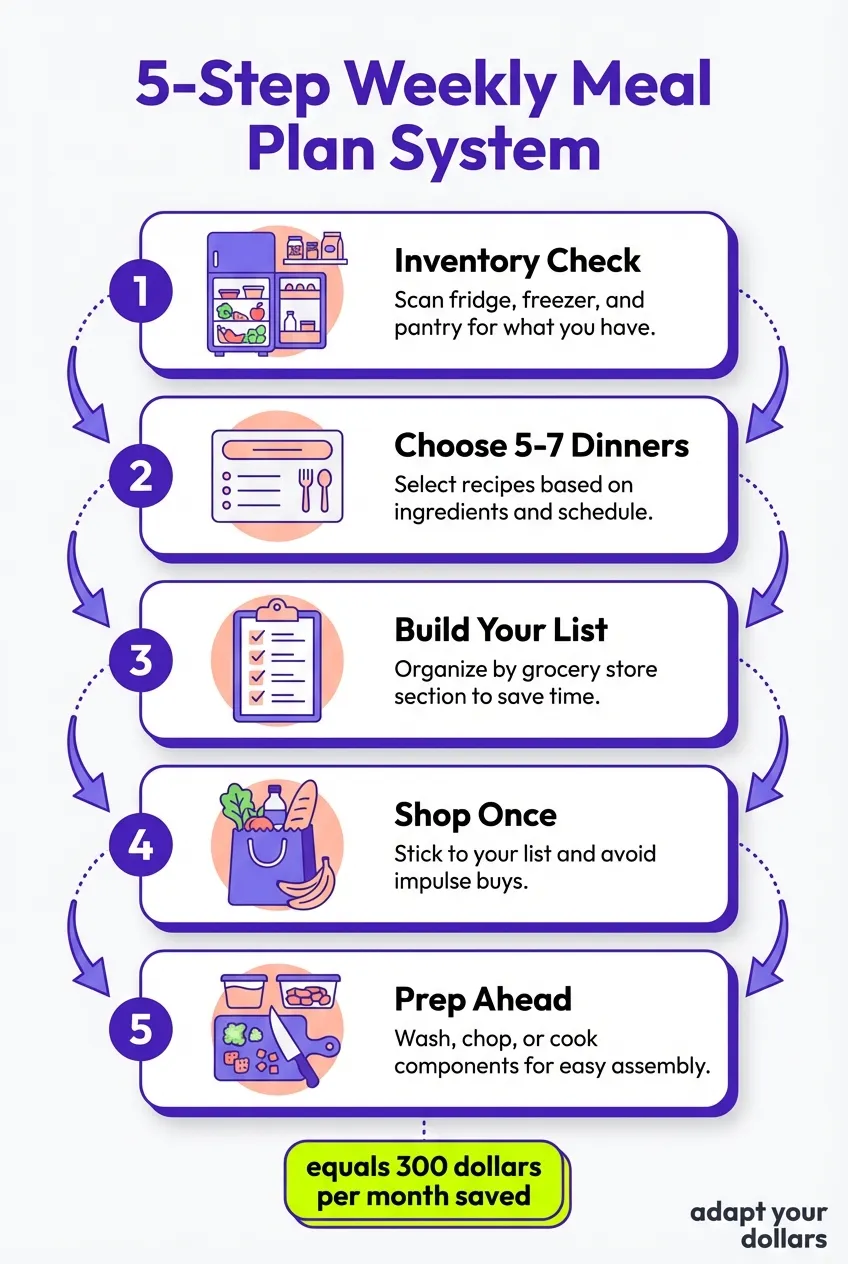
Step 1: Check What You Already Have (3 Minutes)
Before you plan anything, do a quick inventory:
- Fridge: What proteins need to be used this week? Any vegetables about to turn? Leftover sauces or bases?
- Freezer: What’s been in there longest? Any proteins you can thaw?
- Pantry: What staples are running low? What needs to get used up?
This step prevents buying duplicates and helps you build meals around what you already have. If you’ve got ground beef that needs cooking, that becomes the star of at least two meals this week. Check out these cheap food items that are always smart to keep stocked.
Step 2: Pick 5-7 Dinners (5 Minutes)
Here’s where people overcomplicate things. You don’t need 7 unique, Instagram-worthy meals. You need 5-7 dinners that:
- Use ingredients that overlap (buy one rotisserie chicken, use it three ways)
- Include at least 2 “leftover nights” (Wednesday’s stir-fry becomes Thursday’s rice bowls)
- Have 1-2 super easy backups (frozen pizza, pasta with jarred sauce)
My rotation approach:
- Monday: Slow cooker or one-pot meal (minimal effort after the weekend)
- Tuesday: Sheet pan dinner (protein + veggies, one pan)
- Wednesday: Leftovers remix
- Thursday: Taco/bowl night (versatile base)
- Friday: Easy comfort food
- Saturday: Something slightly more involved (if you want)
- Sunday: Soup or meal prep for the week
Need dinner inspiration? Here are some easy frugal meals that work perfectly with this system.
Step 3: Fill In Breakfasts and Lunches (5 Minutes)
Don’t overthink these. Repetition is your friend.
Breakfast options (pick 2-3 for the week):
- Oatmeal with toppings
- Eggs any style
- Yogurt with fruit
- Smoothies
- Toast with nut butter
- Meal prep breakfast options
Lunch strategy:
- Dinner leftovers (the ultimate budget move)
- Simple sandwiches or wraps
- Salads built from dinner ingredients
- Soup from the freezer
Check out these lunch ideas for work that pair perfectly with weekly meal planning.
Shopping for one? Traditional meal plans are built for families of 4. If you’re solo, check out my grocery list on a budget for 1 person to avoid the single-person penalty at the store. And if you want a complete week-by-week meal plan for singles with 2026 USDA prices, that $57 plan delivers real numbers and zero food waste.
Step 4: Build Your Grocery List by Store Section (5 Minutes)
Now turn your meal plan into a shopping list. Here’s the key: organize by store section so you’re not zigzagging back and forth.
My list format:
- Produce (all fruits and vegetables)
- Meat/protein
- Dairy
- Bread/bakery
- Frozen
- Pantry staples
- Other (household items)
Go through each meal and write down exactly what you need, checking against what you already have from Step 1.
Pro tip: Keep a running list on your fridge throughout the week. When you use the last of something, write it down immediately. Then just add your meal-specific items on planning day.
Step 5: Add Quantities and Stick to the List (2 Minutes)
This is where discipline matters. Write actual quantities:
- Not “chicken” but “2 lbs chicken thighs”
- Not “bananas” but “1 bunch (6 bananas)”
- Not “cereal” but “1 box oatmeal”
Then here’s the rule: If it’s not on the list, it doesn’t go in the cart. That’s it. That’s the whole secret to cutting food expenses.
The only exception? Unadvertised manager specials on proteins you’ll definitely use within the week. A $3 marked-down pork loin? Grab it and adjust tomorrow’s plan.
Sample 7-Day Meal Plan With Complete Grocery List
Enough theory. Here’s an actual weekly meal plan for a family of four, plus the exact grocery list you’d need. Total estimated cost: $95-110.
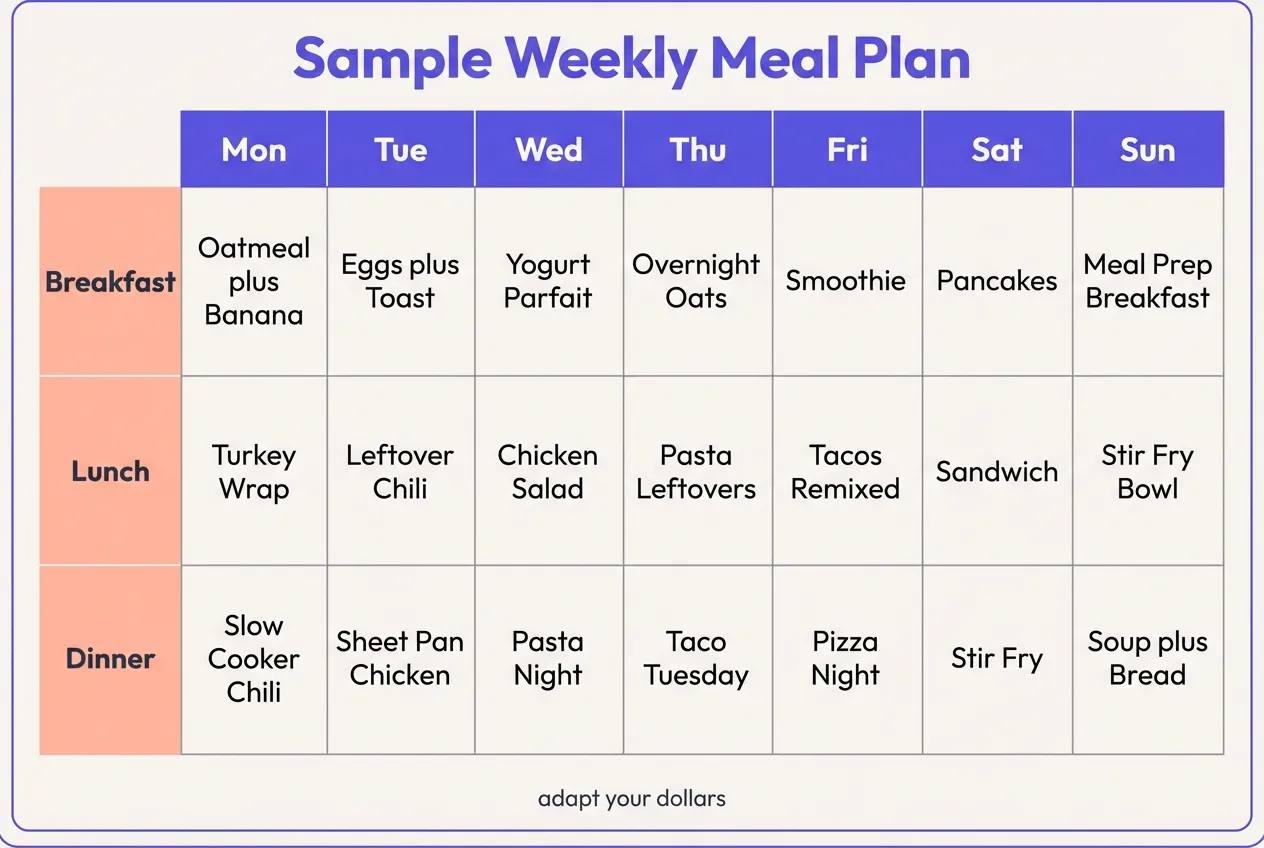
The Meal Plan
Monday
- Breakfast: Oatmeal with banana and cinnamon
- Lunch: Turkey and cheese sandwiches, apple slices
- Dinner: Slow Cooker Chili (ground beef, beans, tomatoes, spices) with cornbread
Tuesday
- Breakfast: Scrambled eggs with toast
- Lunch: Leftover chili over rice
- Dinner: Sheet Pan Chicken Thighs with roasted broccoli and potatoes
Wednesday
- Breakfast: Yogurt parfaits with granola
- Lunch: Chicken salad sandwiches (using leftover chicken)
- Dinner: Pasta with meat sauce (ground beef from chili batch) and side salad
Thursday
- Breakfast: Overnight oats
- Lunch: Pasta leftovers
- Dinner: Taco night (seasoned ground beef, all the fixings)
Friday
- Breakfast: Smoothies (banana, yogurt, frozen fruit)
- Lunch: Taco salad bowls with leftovers
- Dinner: Homemade pizza (store-bought dough, simple toppings)
Saturday
- Breakfast: Pancakes with fruit
- Lunch: Grilled cheese and tomato soup
- Dinner: Stir-fry with rice (use up remaining vegetables)
Sunday
- Breakfast: Big breakfast (eggs, toast, fruit)
- Lunch: Sandwiches
- Dinner: Soup night (use any remaining vegetables) with crusty bread
For more dirt cheap meal ideas, check out our complete guide.
The Complete Grocery List
Produce
- Bananas (2 bunches)
- Apples (4)
- Broccoli (2 heads)
- Potatoes (3 lbs bag)
- Tomatoes (4)
- Lettuce head (1)
- Onions (3)
- Bell peppers (3)
- Garlic (1 head)
- Lemon (1)
- Frozen mixed fruit (1 bag)
- Fresh fruit for pancakes (your choice)
Meat/Protein
- Ground beef (2.5 lbs)
- Chicken thighs (2 lbs)
- Turkey deli meat (1 lb)
- Eggs (18 count)
Dairy
- Milk (1 gallon)
- Shredded cheese (1 bag)
- Sliced cheese (1 pack)
- Plain yogurt (large container)
- Butter (1 lb)
- Sour cream (small)
Bread/Bakery
- Sandwich bread (1 loaf)
- Hamburger buns or slider buns
- Pizza dough (fresh or frozen)
- Crusty bread (for soup night)
- Tortillas (1 pack)
Pantry
- Oatmeal (large container)
- Pasta (2 boxes)
- Rice (2 lb bag)
- Canned diced tomatoes (2 cans)
- Tomato sauce (2 cans)
- Canned beans (kidney and black, 3 cans total)
- Chicken broth (1 carton)
- Canned tomato soup (2 cans)
- Cornbread mix (1 box)
- Granola (1 bag)
- Pancake mix
- Soy sauce
- Olive oil (if low)
- Taco seasoning
- Basic spices (check what you have)
Frozen
- Frozen mixed vegetables (for stir-fry backup)
Why This Plan Works
Notice a few things:
- Ground beef appears in three meals (chili, pasta sauce, tacos) -buy in bulk, portion out
- Chicken does double duty (sheet pan dinner → chicken salad the next day)
- Leftovers are built into the plan (not an afterthought)
- Friday and Saturday are relaxed (you’ve earned it)
- Sunday clears the fridge (nothing wasted)
If you want to take this further, learn how to create a meal planning binder to keep all your winning meal plans organized.
Meal Planning Tips That Actually Make a Difference
After years of doing this, here are the tricks that moved the needle most for me.
Buy Proteins in Bulk and Portion Immediately
When chicken thighs go on sale, buy 5-10 pounds. Come home, portion into freezer bags (1-2 lbs each), label with the date, and freeze flat. Same with ground beef. This alone has saved me hundreds.
Use the “One Protein, Three Ways” Method
Instead of buying 5 different proteins for 5 different meals:
- Buy one rotisserie chicken ($5-7)
- Monday: Chicken with sides
- Wednesday: Chicken tacos
- Thursday: Chicken soup
One purchase, three dinners, zero waste.
Make Friends With Your Freezer
Your freezer is a time machine for food. Use it for:
- Batch-cooked grains (rice, quinoa)
- Leftover soup portions
- Overripe bananas (for smoothies and baking)
- Bread that’s about to go stale
- Herbs in olive oil (ice cube trays)
Speaking of freezers, doing a monthly “freezer audit” is one of those unusual frugal tips that prevents waste - most people have $50-100 worth of forgotten food buried in their freezer right now.
Plan Around the Sales Flyer
Check your grocery store’s weekly ad before you plan. If pork chops are $1.99/lb instead of $4.99, that’s your protein for the week. Let the deals guide your plan, not the other way around.
Want to take this further? Learn unusual frugal tips like mastering your store’s markdown schedule - most stores mark down meat and bakery items at the same time every week. Once you know the pattern, you can time your shopping to save 30-50% on proteins.
Keep a “Master List” of Your Staples
Create a checklist of items you always need to have on hand. Check it before you shop. This prevents the “we’re out of olive oil” crisis mid-cooking.
If you stop eating out and combine it with meal planning, you’ll see your food budget transform almost immediately.
What to Do When Life Derails Your Plan
Let’s be real: some weeks fall apart. Kid gets sick. You work late. Plans change. Here’s how to handle it without blowing your budget.
Have a “Break Glass” Meal List
Keep 2-3 emergency meals that require almost zero effort:
- Frozen pizza + bagged salad
- Pasta + jarred sauce + frozen vegetables
- Quesadillas with whatever cheese and leftovers you have
- Eggs and toast (breakfast for dinner always works)
These aren’t failures. They’re planned flexibility.
Embrace the Pivot
Didn’t make Wednesday’s stir-fry? Those vegetables don’t expire today. Push it to Thursday. The plan is a guide, not a prison sentence.
Batch Cook on Good Weeks
When you do have time and energy, make double. Freeze half. Future-you will be grateful when chaos strikes and there’s homemade soup in the freezer.
Your Next Step: Just Start
Here’s what I need you to do right now:
Take 20 minutes this Sunday. Pull out a piece of paper. Open your fridge. And plan just five dinners for next week.
Don’t make it complicated. Don’t aim for perfect. Just pick five dinners, write down what you need, and go shopping with a list.
That’s it. That’s the whole system that saves $300+ per month.
Will your first week be flawless? Probably not. Mine wasn’t. I forgot to buy onions for literally every recipe that needed them. But even that imperfect first week was better than the aimless wandering I’d been doing.
The average American family throws away $1,500 worth of food per year. They spend another $3,000+ on unplanned takeout. A simple meal plan attacks both problems simultaneously.
You don’t need an app. You don’t need a Pinterest board. You don’t need to become a meal-prep influencer. You just need a plan, a list, and the willingness to try.
Your grocery store trips are about to get shorter, cheaper, and way less stressful. And that $300? Put it toward your emergency fund, pay down debt, or just breathe a little easier knowing you’ve got margin in your budget.
Start this Sunday. Your future self -and your bank account -will thank you.

Written by
Chris
I went from checking my bank balance before every grocery run to building a $10K emergency fund. Now I share the exact strategies that worked—no jargon, no judgment.