
I used to think I was frugal. I’d obsess over exact weekly budget numbers, calculating every dollar down to the cent. I thought that level of control was the answer.
Then I tracked my actual spending for three months.
Turns out, I was missing hundreds of dollars in invisible waste - stuff that never showed up in my careful weekly tallies because it was baked into habits I didn’t question. The phantom electricity drain from devices I thought were “off.” The grocery store markdown schedule I’d never bothered to learn. The library services I was paying subscriptions to duplicate.
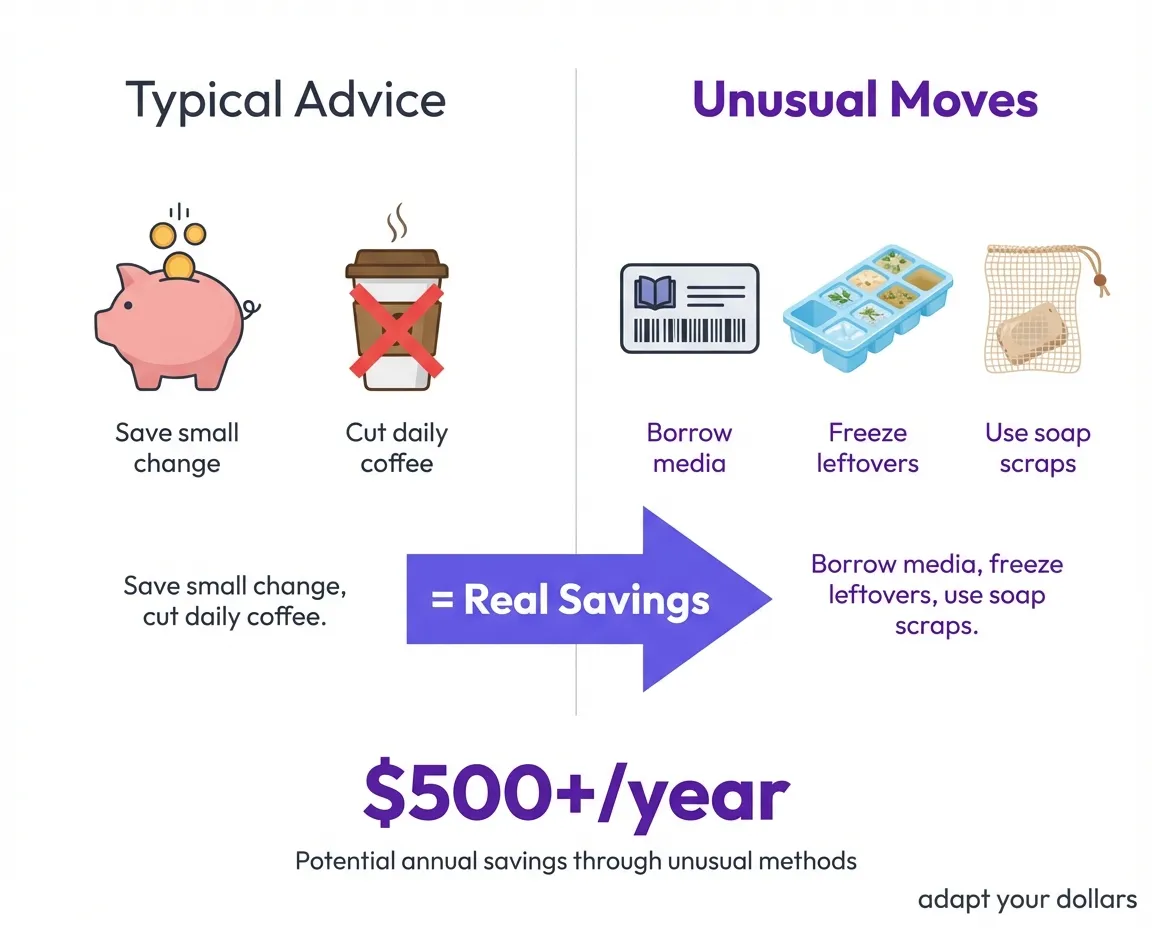
The usual frugal advice? You’ve heard it. Make coffee at home. Cancel Netflix. Brown bag your lunch. That stuff works, but everyone’s already doing it - or they’ve heard it so many times they tune it out.
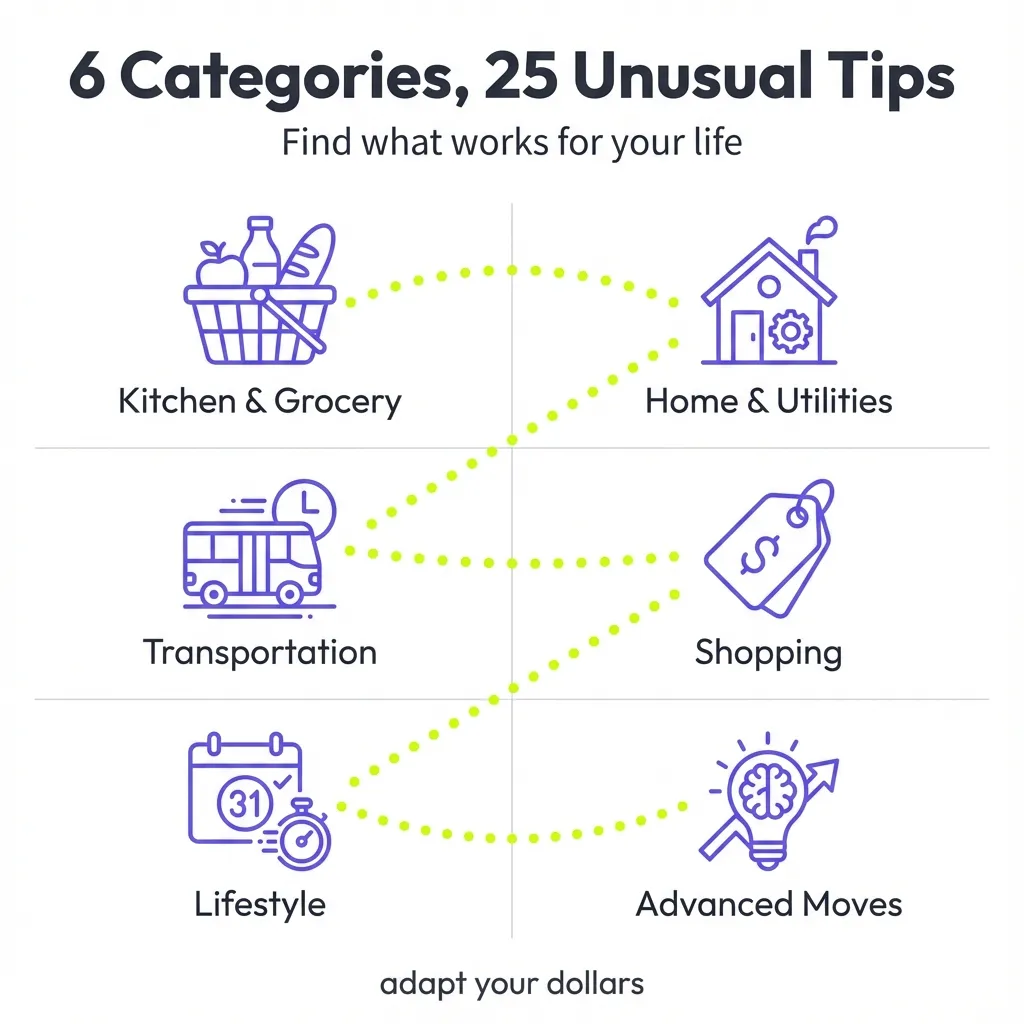
These 25 tips are different. They’re the unusual ones that actually moved the needle when I got serious about saving money in ways that feel almost too extreme - but actually aren’t once you try them. Real numbers. Effort ratings. No judgment on which ones fit your life.
Let’s get into it.
Kitchen and Grocery Savings
1. Master the Markdown Schedule at Your Grocery Store
Savings: $40-80/month Effort: Low (one conversation) Best for: Anyone who shops at the same store regularly
Every grocery store has a markdown schedule. Meat gets marked down Tuesday mornings at my local store. Bakery items hit 50% off at 7pm daily. Produce clearance happens Wednesday afternoons.
Here’s the move: Ask the butcher or bakery manager directly. Most will tell you exactly when they do markdowns. Then adjust your shopping day accordingly.
I started buying marked-down meat and freezing it immediately. Same quality, 30-50% less money. Over a year, that’s $480-960 back in your pocket.
2. Grow a “Cut and Come Again” Window Garden
Savings: $15-25/month Investment: $20-30 one-time Effort: Low (5 minutes daily) Best for: Renters and homeowners alike
Forget trying to grow tomatoes in an apartment. Focus on lettuce, spinach, green onions, and herbs - things you can harvest repeatedly from the same plant.
A sunny windowsill, some basic containers, and cheap seeds. Green onions regrow from scraps you’d throw away anyway. Lettuce keeps producing for months. Fresh herbs cost $3-4 per bunch at the store but pennies to grow.
The ROI here is excellent: $25 in startup costs can yield $200+ in produce over a year.
3. Use the “Freezer Audit” Method Monthly
Savings: $30-50/month in reduced waste Effort: Medium (30 minutes monthly) Best for: Families, batch cookers
Most people have $50-100 worth of forgotten food in their freezer right now. Do a monthly audit: pull everything out, check dates, and plan the week’s meals around what needs to be used.
I found a pork roast I’d completely forgotten about. That’s a $15 dinner I almost threw away.
Build your weekly meal plan with grocery list around your freezer audit, not the other way around.
4. Negotiate Produce Prices at Farmers Markets
Savings: 20-40% off produce Effort: Low (just ask) Best for: Farmers market shoppers, people comfortable negotiating
Most people don’t realize farmers market prices are negotiable, especially near closing time. Farmers would rather sell at a discount than pack up unsold produce.
The script: “Would you take $X for this?” or “What’s your best price if I buy three of these?”
Near closing, try: “I’d love to take these off your hands - what could you do?”
Works about 70% of the time. Worst case, they say no.
Related Reading: If you’re shopping solo, check out our grocery list on a budget for 1 person - the math changes completely when you’re feeding just yourself.
Home and Utilities
5. Unplug “Vampire” Devices (They’re Costing You $100+/Year)
Savings: $100-200/year Effort: Low (use power strips) Best for: Everyone, especially those with older electronics
According to the Department of Energy, standby power (vampire draw) accounts for 5-10% of residential electricity use. That’s $100-200 annually for the average home.
The biggest offenders: gaming consoles, cable boxes, computer monitors, phone chargers, and anything with a digital clock or standby light.
Solution: Smart power strips that cut power when devices are off, or just unplug things manually. I put my entertainment center on a power strip and flip it off when not in use. Took two weeks to become automatic.
6. Switch to LED Bulbs Room by Room
Savings: $75-150/year Investment: $30-50 one-time Effort: Very low Best for: Homeowners and renters (take them when you move)
If you haven’t switched yet, LEDs use 75% less energy than incandescent bulbs and last 25 times longer. A single LED bulb saves about $7/year in electricity.
Don’t replace everything at once. Replace bulbs as they burn out, or start with high-use areas (kitchen, living room). ROI is typically under one year.
7. Use the “Thermal Layer” Strategy for Climate Control
Savings: $20-40/month on heating/cooling Effort: Medium Best for: People in extreme climates, older homes
Instead of heating or cooling your entire house to the same temperature, create thermal zones. Close vents in unused rooms. Use space heaters strategically. In summer, use fans to create airflow rather than cranking AC.
Winter tip: A heated mattress pad ($40-60) uses far less electricity than heating your whole bedroom all night. Same comfort, fraction of the cost.
8. Make Your Own Cleaning Products
Savings: $100-200/year Investment: $15-20 one-time Effort: Low once you learn recipes Best for: Anyone, especially those with sensitivities to commercial products
White vinegar, baking soda, castile soap, and essential oils can replace almost every cleaning product under your sink.
Basic all-purpose cleaner: 1 part white vinegar, 1 part water, few drops dish soap. Costs about $0.50 per spray bottle vs $4-6 for commercial versions.
Glass cleaner, bathroom cleaner, floor cleaner - all can be made for pennies. There’s a learning curve, but once you have your recipes dialed, you’ll never go back.
9. Install a Programmable Thermostat (Or Use the One You Have)
Savings: $150-180/year Investment: $25-250 (basic to smart) Effort: Low after setup Best for: Homeowners, long-term renters with permission
The Department of Energy estimates you can save about 10% on heating and cooling by turning your thermostat back 7-10 degrees for 8 hours a day.
The key: Set it and forget it. Program it to drop when you’re at work and sleeping. Many people have programmable thermostats they’ve never actually programmed.
Smart thermostats learn your patterns and optimize automatically. Payback period is typically under 2 years.
Transportation and Commuting
10. Use the “Hypermiling” Technique
Savings: 10-20% on gas ($200-400/year for average driver) Effort: Medium (behavior change) Best for: Daily commuters, anyone with a long drive
Hypermiling is a set of driving techniques that maximize fuel efficiency:
- Accelerate gently (pretend there’s an egg under the gas pedal)
- Coast to red lights instead of braking hard
- Maintain steady speeds
- Keep tires properly inflated (+3% efficiency)
- Remove roof racks when not in use (5-25% drag reduction)
I improved my fuel economy from 28 to 33 mpg just by changing how I drive. At current gas prices, that’s real money.
11. Stack Errands Geographically
Savings: $50-100/month on gas Effort: Low (just planning) Best for: Suburban drivers, families
Instead of making separate trips for groceries, pharmacy, and the hardware store, plan routes that hit everything in one efficient loop.
Better yet, batch your errands weekly. One trip on Saturday instead of four trips throughout the week. Less gas, less time, less impulse spending at each stop.
12. Maintain Your Car on Schedule (It’s Cheaper Than Repairs)
Savings: $500-2,000/year in avoided repairs Investment: $200-400/year in maintenance Effort: Low (just schedule it) Best for: Anyone with a car over 3 years old
Skipping oil changes to save $40 can cost you a $4,000 engine replacement. Ignoring worn brakes can damage rotors. Neglecting tire rotation leads to premature replacement.
Keep a simple log. Follow the manufacturer’s maintenance schedule (in your owner’s manual). Budget $50-100/month for maintenance and you’ll almost always come out ahead vs. major repairs.
Shopping and Spending
13. Use the “72-Hour Rule” for All Non-Essential Purchases
Savings: Varies widely ($500-2,000/year for most people) Effort: Low (just wait) Best for: Impulse buyers, online shoppers
Before buying anything non-essential over $25, wait 72 hours. Put it in your cart and walk away. Most of the time, you’ll forget about it or realize you don’t actually need it.
This single habit probably saves me $100/month on stuff I would have bought, used once, and regretted.
14. Borrow Before You Buy
Savings: $50-200/month depending on hobbies Effort: Low Best for: DIYers, hobbyists, parents
Before buying any tool, equipment, or gear - ask: “Can I borrow this?”
- Libraries lend more than books (see tip #25)
- Neighbors have tools you’ll use once
- Buy Nothing groups and local Facebook groups
- Tool libraries exist in many cities
I’ve borrowed a pressure washer, circular saw, and carpet cleaner in the past year. Saved easily $200+ on stuff I’d have used once and stored forever.
15. Buy Generic for 80% of Products
Savings: 20-40% on groceries and household goods Effort: Very low Best for: Everyone
Store brands are manufactured in the same facilities as name brands about 80% of the time. The difference is literally just packaging and marketing.
Start with: medications (FDA requires identical active ingredients), cleaning supplies, pantry staples, and dairy. Keep name brands only where you genuinely notice a quality difference.
Generic Benadryl is identical to name brand but costs 60% less. Same for ibuprofen, cereal, cheese, flour, sugar, and most canned goods.
16. Use Cashback Apps and Credit Card Rewards Strategically
Savings: $300-600/year Effort: Low after setup Best for: People who pay their credit card in full monthly
This only works if you pay your balance in full. Credit card interest will destroy any rewards.
Stack your savings: cashback credit card (2-5%) + store app rewards + manufacturer coupons. On a $600/month grocery budget, that’s $150-300/year just from the credit card.
Cashback apps like Ibotta, Fetch, and Checkout 51 add another layer. 10-15 minutes of setup, then scan receipts. I average $20-30/month with minimal effort.
Lifestyle and Services
17. Call and Negotiate Every Annual Bill
Savings: $200-500/year Effort: Medium (phone calls) Best for: Anyone paying for recurring services
Once a year, call every service provider and ask for a better rate: internet, phone, insurance, subscriptions. The script is simple: “I’ve been a customer for X years. What can you do to lower my bill?”
Success rate is surprisingly high - about 70% for me. Even a $10/month reduction on three services is $360/year.
Insurance is the big one. Get quotes from competitors annually, then call your current provider with those numbers.
18. Use the Library Like It’s 1995
Savings: $50-150/month Effort: Very low Best for: Readers, movie watchers, families
Your library card gives you free access to:
- Books, audiobooks, ebooks (Libby app)
- DVDs and streaming services (Kanopy, Hoopla)
- Magazine and newspaper subscriptions
- Museum passes (many libraries have these)
- Learning platforms (LinkedIn Learning, language apps)
If you’re paying for Audible ($16/month), newspapers ($15/month), and streaming services ($15-50/month), your library likely offers all of it free.
19. Host Potlucks Instead of Picking Up the Tab
Savings: $100-200/month on dining out Effort: Medium Best for: Social people, those who entertain
Dinner out with friends: $50-100. Hosting a potluck: $15-20 for your contribution plus whatever’s already in your pantry.
You still get the social connection without the restaurant markup. Better conversations too - no competing with background noise.
20. Use Your Employer’s Overlooked Benefits
Savings: $500-2,000+/year Effort: Low (just research) Best for: W-2 employees
Most people don’t use half their employer benefits. Check for:
- HSA employer contributions (free money)
- 401k match (literally free money you’re leaving on table)
- Employee discounts (often 10-25% at major retailers)
- Gym membership subsidies
- Transit benefits (pre-tax dollars)
- Employee Assistance Programs (free therapy sessions, financial counseling)
If your employer matches 401k contributions, not contributing at least to the match is turning down free money. Even our 2026 budget templates build in retirement contributions for this reason.
Advanced Frugal Moves
21. Time-Shift Your Electricity Usage
Savings: $20-50/month Effort: Medium Best for: People with time-of-use electricity rates
Many utilities now have time-of-use rates where electricity costs 2-3x more during peak hours (typically 4pm-9pm).
Run dishwasher, laundry, and other high-draw appliances during off-peak hours. Some smart plugs can automate this. Check if your utility offers time-of-use plans - the savings can be substantial.
22. Practice “Inventory Shopping” Before Grocery Runs
Savings: $30-60/month Effort: Low (15 minutes weekly) Best for: Families, batch cookers
Before writing your grocery list, shop your own kitchen first. Check every cabinet, the back of the fridge, the freezer. Build meals around what you already have.
Most households have 1-2 weeks of meals hiding in their existing inventory. You just have to look.
23. Use the “Cost Per Use” Calculation for Big Purchases
Savings: Prevents $100s-1,000s in regretted purchases Effort: Low (just math) Best for: Anyone considering a significant purchase
Before any purchase over $50, calculate the cost per use:
A $200 coat worn 100 times = $2/wear. Good investment. A $200 gadget used 5 times = $40/use. Bad investment.
This mental model stops emotional purchases and helps you invest in quality where it matters.
24. Join a Buy Nothing Group
Savings: $50-200/month Effort: Low Best for: Community-minded people, parents
Buy Nothing groups exist in most neighborhoods on Facebook. People give away everything from furniture to baby gear to extra garden produce.
I’ve gotten a working vacuum, kids’ clothes, moving boxes, and plant cuttings - all free. The catch is you give things away too, which clears clutter and helps neighbors.
25. Check Your Local Library of Things
Savings: $100-500/year on tools and equipment Effort: Low Best for: DIYers, hobbyists, renters
A growing number of libraries and community organizations now lend tools, camping gear, kitchen appliances, and more. There are approximately 60+ “Library of Things” locations across the US.
Before buying a tent for one camping trip, a sewing machine for one project, or a power washer for one afternoon - check if you can borrow it.
Making This Actually Work
Here’s the reality: you won’t do all 25 of these. You shouldn’t even try.
Pick three that fit your life. Master those. Then maybe add another.
The tips that save me the most:
- Markdown schedule mastery - $60/month average
- 72-hour rule - probably $100/month in avoided purchases
- Generic switching - $50/month on groceries
- Annual bill negotiation - $400/year in one afternoon
That’s over $3,000/year from four habits.
Your numbers will be different. Someone who drives a lot will get more from hypermiling. Someone who hosts often will save more on potlucks. Someone with time-of-use electricity rates might save significantly on tip #21.
Start with the ones that match your biggest spending categories. That’s where the leverage is.
What’s your favorite unusual frugal tip? Drop it in the comments - I’m always looking for new ones to test.
Want more strategies like these delivered to your inbox? Sign up for the Adapt Your Dollars newsletter - one actionable money tip every week, no fluff.

Written by
Chris
I went from checking my bank balance before every grocery run to building a $10K emergency fund. Now I share the exact strategies that worked—no jargon, no judgment.